
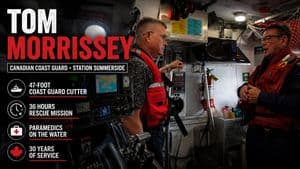
What Happens When Canada’s Coast Guard Gets the Call? ft. Tom Morrissey
When a distress call hits the water, Canada’s Coast Guard has minutes to choose the right vessel, crew and route.
Tom Morrissey reveals what rescue looks like in hurricane-force winds, pitch-black nights and searches lasting up to 36 hours.
In this episode, we break down:
- Why Tom Morrissey joined the Canadian Coast Guard and how growing up in a PEI fishing family shaped his career
- How Coast Guard search and rescue operations cover PEI, New Brunswick, Nova Scotia and the Northumberland Strait
- How crews decide between a fast rescue craft and a 47-foot high-endurance motor lifeboat
- Why the Coast Guard cutter can operate in extreme weather and self-right after a rollover
- What happens when crews search for people at night using spotlights, night vision and specialized navigation equipment
- The reality of 24/7 maritime search and rescue missions that can last as long as 36 hours
- How Canadian Coast Guard rescue specialists provide emergency medical care on the water
- Inside the cutter’s cockpit, communications systems, shock-mitigating seats and watertight compartments
- Why the survivors compartment is essentially a “tin can ambulance” built for emergency care at sea
- How decades of experience, mentorship and hands-on training prepare the next generation of Coast Guard crews
- Hosts: Paul Micucci
- Guests: Tom Morrissey
Timestamps:
- 00:00 Intro
- 00:38 Why Tom Morrissey joined the Canadian Coast Guard
- 02:33 The massive search and rescue territory around PEI
- 03:42 How crews choose the right rescue vessel
- 06:33 The 47-foot Coast Guard cutter built for extreme weather
- 08:56 What happens when a rescue vessel gets knocked down
- 10:19 Why so many Coast Guard calls happen after dark
- 13:16 Departure checks and the flybridge search platform
- 15:10 How a rescue mission can last 36 hours
- 17:03 The adrenaline of responding to someone in distress
- 18:34 Coast Guard crews as paramedics on the water
- 21:09 Training, experience and learning under pressure
- 23:34 How Coast Guard technology continues to evolve
- 24:36 Crew fatigue, night vision and searching the water
- 28:23 Inside the cutter’s navigation and communications cockpit
- 31:23 Shock-mitigating seats and a vessel designed to survive
- 35:22 Inside the Coast Guard’s “tin can ambulance”
- 39:40 Coast Guard careers, recruitment and shift work
- 41:08 More than 30 years of service and mentoring the next generation
If you enjoyed this, don’t forget to like, subscribe, and share your thoughts in the comments.
Visit https://www.tplmedia.ca
Pillars: Defence
#CanadianCoastGuard #SearchAndRescue #MaritimeSafety #PEI #CoastGuard
RELATED VIDEOS

Why Canada Risks Losing the Snowbirds' Flying Edge ft. Dan Dempsey
What does it take to fly wingtip-to-wingtip at 300 feet—and trust eight other pilots with your life in a Snowbirds formation? For
Jim Lang
Why Kelowna Still Thrives Through Wildfires & High Costs ft. Denys Storozhuk
Kelowna looks like paradise—but wildfire smoke, high costs, and seasonal business raise a bigger question: what keeps the Okanagan
Mike Wixson

The Arctic: Canada's Northern Development
Canada's Arctic is becoming one of the world's most important geopolitical hotspots, and the country may be running out of time to
Jim Lang, Paul Micucci

All the content you need for every media platform
Sponsored Ad
Camp X: Canada’s Secret Spy School & The Real James Bond | ft. Robbie Cressman
Hidden along the shores of Lake Ontario during the Second World War was one of the most secretive intelligence training facilities
Mike Wixson

Is Canada’s Democracy Already Broken? ft. Liam DeBoer
What happens when elections, scandals, floor crossings, and foreign influence all start looking connected in Canada’s political sy
Brian Isted
Canada’s Military Fix Is Bigger Than New Gear
Canada is finally spending on defence—but can the CAF fix broken gear, housing, and recruiting fast enough? Brian Isted explains
Jim Lang, Brian Isted

Exciting promotions on rkitchen.ca
Sponsored Ad