
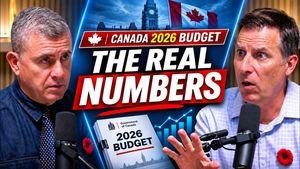
Carney’s 2026 Budget: Who Really Benefits? | Part 1/4
Billions for major projects and tax breaks—but how much relief will Canadians actually see?
Part 1 of 4: The promises, debt and economic reality.
In Part 1 of our four-part Canadian Federal Budget Breakdown series, Jim Lang and Paul Micucci begin a comprehensive examination of Mark Carney’s 2026 budget, exploring the government's economic vision, massive spending commitments, and the challenges facing everyday Canadians.
In this episode, we break down:
- Carney’s 2026 Federal Budget: The five major sections of the budget, the government's economic priorities, and what Canadians need to understand.
- Canada’s National Debt: Why the government's G7 debt rankings are being questioned, the controversy over pension assets, and the growing cost of servicing Canada's debt.
- The Investment Supercycle: Carney's ambitious strategy to attract billions in investment and why Canadians may have to wait until the 2030s to see meaningful results.
- Corporate Tax Breaks: The mega productivity deduction, Canada's competitive corporate tax strategy, and whether attracting foreign investors will benefit ordinary Canadians.
- Housing and Affordability: The proposed $44.7 billion housing investment, the federal government's expanding role in construction, and concerns about the Canadian housing market.
- Energy, AI, and Natural Resources: Major investments in electricity, nuclear power, artificial intelligence, critical minerals, and infrastructure development.
- Defence Spending: Canada's NATO commitments, military procurement, fighter jet purchases, and the financial challenges of rebuilding national defence capabilities.
- Canada's Cost of Living Crisis: Rising grocery bills, homelessness, government benefits, and the disconnect between long-term investment promises and immediate household needs.
- Major Projects and Skilled Labour: Why worker shortages, construction timelines, and government bureaucracy could slow Canada's economic transformation.
- The Bigger Economic Picture: Can Canada afford its ambitious plans, and how long will it take before Canadians experience the benefits?
This is Part 1 of a four-part TPL Media special series examining Canada's 2026 federal budget. Across the series, we take a closer look at the spending commitments, economic assumptions, government revenues, and long-term implications of Carney's financial strategy.
Follow the full series as we continue examining where the money is going, what the government expects in return, and what it all means for Canada's economic future.
- Hosts: Jim Lang, Paul Micucci
Timestamps:
- 00:00 Intro – Budget confrontation and affordability concerns
- 03:12 Breaking down the five pillars of Carney’s budget
- 06:10 Global economic uncertainty and Canada’s strategy
- 09:07 Corporate tax incentives and Canada's natural resources
- 12:38 Is Canada’s G7 debt ranking misleading?
- 15:44 Rising national debt and future interest payments
- 18:55 Bond yields, credit ratings, and market volatility
- 22:00 Federal government spending and public-sector cuts
- 25:05 Toronto Stock Exchange and critical minerals
- 28:00 Operating budgets vs. capital spending explained
- 31:57 Electricity, nuclear power, and infrastructure expansion
- 35:00 The $44.7 billion housing investment debate
- 38:26 Food security, grocery competition, and Canadian products
- 41:27 AI investment and Canadian defence manufacturing
- 44:03 Why Canada still struggles with internal trade barriers
- 47:44 Skilled trades shortages and export diversification
- 50:34 Why Canada’s investment supercycle could take a decade
- 53:41 Foreign investment, major projects, and airport privatization
- 56:10 The mega productivity deduction and corporate taxes
- 59:52 Energy investments and the progress of major projects
1:03:04 Canada Strong Fund and opportunities for investors
1:06:09 Grocery benefits, student assistance, and affordability
1:09:11 Homelessness funding and the affordable housing challenge
1:12:51 Community investments and Indigenous infrastructure
1:15:20 NATO commitments and Canada’s military spending
1:18:07 Crime prevention, public safety, and government priorities
1:20:38 Final thoughts – How long before Canadians see results?
Don't miss Parts 2, 3, and 4 of our Canadian Budget Breakdown series as we continue digging into the numbers, spending priorities, and economic decisions shaping Canada's future.
If you enjoyed this, don’t forget to like, subscribe, and share your thoughts in the comments.
Visit https://www.tplmedia.ca
Pillars: Economy
#CanadaBudget2026 #MarkCarney #CanadianEconomy #FederalBudget #CanadaPolitics
RELATED VIDEOS
New Garbage Tariff Exposes Ontario’s Waste Crisis
Visit https://www.tplmedia.ca Trump's 50% garbage tariff could leave Ontario facing a costly waste crisis. Are Canadian taxpayer
Mike Wixson, Paul Micucci
Carney’s Budget: What Will It Mean for Your Wallet?
Visit https://www.tplmedia.ca for full video and more. Canada’s debt is climbing as families face higher bills and borrowing cost
Paul Micucci, Jim Lang
Carney Wants More Immigration—Can Canada Handle It?
Carney wants immigration to rise again. But can Canada handle it? Housing shortages, skilled-worker gaps and backlogs are testing
Paul Micucci, Jim Lang

All the content you need for every media platform
Sponsored Ad
Did the Bank of Canada Just Make a Costly Mistake? ft. Moshe Lander
Visit https://www.tplmedia.ca Canada raised interest rates again. Is the Bank of Canada making a costly mistake? Economist Moshe
Mike Wixson

Tariffs Are Hurting Ghostbusters Star Dan Aykroyd’s Crystal Head Vodka
Dan Aykroyd’s vodka faces a U.S. import ban—and Canadian jobs are at risk. Crystal Head’s Jonathan Hemi warns the trade war could
Mike Wixson

Is Canada About to Feel Trump’s Tariff Pain?
Thanksgiving dinner costs are climbing, diesel is squeezing farmers, and the bigger tariff hit may still be months away. Canada m
Mike Wixson, Paul Micucci, Jim Lang

Exciting promotions on rkitchen.ca
Sponsored Ad